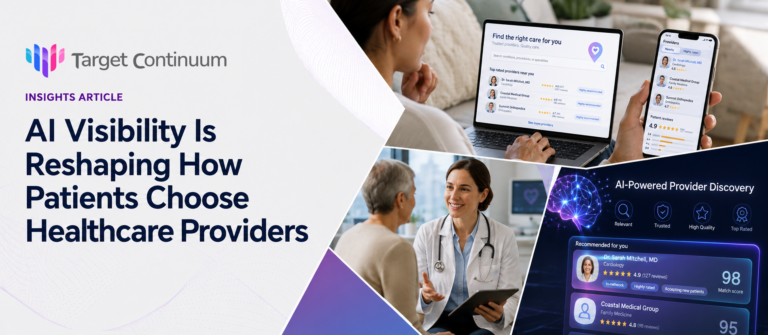
If a service line is not represented in AI-generated responses, it may never even enter the patient’s consideration set.
This is the fifth in a five-part Patient Acquisition Insight series exploring five diagnostic lenses that help diagnose a full picture of where growth is stalling for today’s healthcare organizations, how to use them, and how they drive significant results.
This article focuses on an emerging driver of patient acquisition: AI and future-proofing infrastructure.
Context
For decades, patient discovery followed a relatively predictable path. Patients would search on platforms like Google, visit hospital websites, compare providers, and ultimately schedule care. That journey, while complex, was still largely driven by search behavior and website engagement.
Today, that process is changing in a fundamental way. Patients and caregivers are increasingly turning to AI systems to influence their decisions. Instead of reviewing multiple websites, they are asking AI tools to synthesize answers and recommend options directly.
As a result, visibility is no longer just about where an organization ranks in search results. It is now about whether that organization is recognized, trusted, and surfaced by AI systems in the first place. If a service line is not represented in these AI-generated responses, it may never even enter the patient’s consideration set.
What This Problem Looks Like
Organizations that are not positioned for AI-driven discovery often show similar warning signs. They may rarely appear in AI-generated responses, while competing organizations are recommended more frequently. Clinical expertise may not be clearly represented or easily understood by AI systems, and website content may be structured in ways that are difficult for these systems to interpret.
In addition, reputation signals may be weak, inconsistent, or fragmented across platforms. Claims about expertise or outcomes may not be clearly supported or verifiable, which limits how AI systems evaluate credibility. Many organizations also lack visibility into how AI systems are interpreting their content, making it difficult to diagnose or correct these gaps.
Why This Happens
- AI Systems Prioritize Structured, Verifiable Information
AI models rely on clearly defined entities, consistent terminology, and well-organized data. When content is unstructured or inconsistent, it becomes significantly less likely to be surfaced in AI-generated responses. - AI Relies on External Signals of Authority
AI systems also depend heavily on external signals of authority, including third-party directories, reviews, citations, and other forms of validation. Organizations that lack these signals, or whose presence is inconsistent across sources, are less likely to be recommended. - Reputation Signals Influence AI Recommendations
Patient experience, online reviews, and consistency across digital platforms all influence how trustworthy an organization appears. - Verified Information Matters
AI systems prioritize information that can be verified, meaning that claims must be supported, expertise must be consistently represented, and content must align across multiple sources.
Why Campaigns Alone Don’t Fix This
Most traditional marketing strategies are built on the assumption that visibility comes from paid media, SEO, and website optimization. While these tactics are still important, they do not fully address how AI-driven discovery works.
AI systems do not simply rank pages; they synthesize answers. This means that campaigns may still drive awareness, but they do not necessarily influence whether an organization is included in AI-generated recommendations. If visibility within these systems is limited, organizations may never enter the consideration set at all. In many cases, competitors are surfaced first, which constrains marketing performance before campaigns even have a chance to make an impact.
A Different Way to Approach Patient Acquisition
We see the best results when we treat AI as an emerging layer of patient acquisition that may influence whether patients ever consider your organization.
Before and During Activation, We Identify Where AI Visibility May Be Limiting Growth
This includes evaluating whether the organization appears in AI-generated responses, how clinical expertise is being interpreted, and whether structured data supports accurate representation. We also assess how reputation and external validation influence trust, as well as how competitors are positioned within AI-driven discovery.
What This Requires from the Organization
Addressing these challenges requires a more deliberate approach to how information is structured and validated, including the following:
- assessing how clinical expertise is presented and verified
- reviewing reputation signals and third-party validation
- evaluating AI visibility relative to competitors
How This Supports Activation
When these elements are aligned, patient acquisition campaigns become more effective because they are grounded in how patients are actually discovering care today. Campaigns can then align with emerging AI-driven entry points, rather than relying solely on traditional channels.
This approach ensures that visibility supports long-term growth, not just short-term campaign performance. It creates a foundation where marketing efforts reinforce, rather than attempt to compensate for, upstream discovery challenges.
What Organizations Should Examine First
Before scaling patient acquisition campaigns, organizations should understand:
- whether they appear in AI-generated responses
- how their clinical expertise is represented across digital channels
- strength and consistency of reputation signals
- clarity and structure of website content
- how competitors are positioned in AI-driven discovery
Why This Matters
AI is becoming a new gateway to patient discovery, influencing which organizations are considered before traditional marketing ever occurs.
Organizations that build structured, credible, and consistent digital presence are more likely to be recommended.
Those that do not may become invisible.
Key Takeaway
If patient acquisition is slowing or inconsistent, it may be rooted in visibility within emerging discovery channels that are shaping patient decisions earlier than ever before.
Patient acquisition is no longer driven only by search and referrals. It is increasingly shaped by how AI systems interpret, validate, and recommend care.
Ready to Learn More?
Are you ready to learn more about our Unified Patient Acquisition Method can help you achieve your growth goals?