HMPS26 was a great few days of learning, reconnecting, and listening closely to where healthcare marketing is headed next.
The strongest theme we heard throughout the conference was simple: growth is getting more complex, and marketing teams are being asked to carry more of the burden. Leaders are expected to prove ROI, support service line growth, build trust, modernize digital access, understand patient behavior, strengthen physician relationships, and make smart decisions about AI, data, privacy, and partners.
That is a lot to solve with disconnected campaigns.
It is also why so many conversations at HMPS connected directly to the work we are doing at Target Continuum through our Unified Patient Acquisition Method. Across the agenda, the same questions kept surfacing:
- Where is demand coming from?
- Can patients actually access care?
- Are referral patterns supporting growth or limiting it?
- Is marketing converting interest into scheduled care?
- Is the organization ready for AI, privacy changes, and the next version of patient search?
The 5 Lenses Were Everywhere at HMPS
We counted more than 30 sessions across the agenda that related directly to at least one of the five lenses in our Unified Patient Acquisition Method: Market & Demand Reality, Access & Capacity Readiness, Referral & Physician Confidence, Marketing & Conversion Effectiveness, and AI & Future-Proofing Infrastructure.
Some sessions focused on market and demand reality, including conversations about segmentation, consumer behavior, brand trust, reputation, claims data, market intelligence, and service line opportunity. These sessions pointed to the need for better insight before making growth decisions.
Other sessions connected directly to access and capacity readiness, reinforcing a critical point: generating demand is not enough if the organization cannot convert that demand into scheduled, completed care.
Referral and physician confidence were also major themes. Sessions on the referral journey, data-driven referral growth, physician relations ROI, liaison strategy, field accountability, and niche service line growth all highlighted how much patient acquisition still depends on trust, clinical relevance, and physician behavior.
Marketing and conversion effectiveness showed up throughout the agenda as well. Sessions on true incremental ROI, bottom-of-funnel conversion, full-funnel growth, data-enabled growth, and measurable service line impact all reflected the pressure healthcare marketers feel to prove that campaigns are not just creating activity, but contributing to volume, margin, and enterprise priorities.
And of course, AI and future-proofing were everywhere. From AI search and patient-facing AI to AI agents, AI-ready content, privacy-first marketing, MarTech governance, and innovation frameworks, HMPS made it clear that AI is becoming part of the infrastructure of healthcare growth, patient engagement, digital experience, and marketing operations.
For us, the takeaway was encouraging. The industry is moving toward the same conclusion we have seen in our work with healthcare organizations: patient acquisition cannot be solved through one channel, one campaign, one dashboard, or one vendor. It requires a connected view of the entire growth system.
A Highlight: Mindy Grantham on “Build or Buy” in Healthcare Marketing
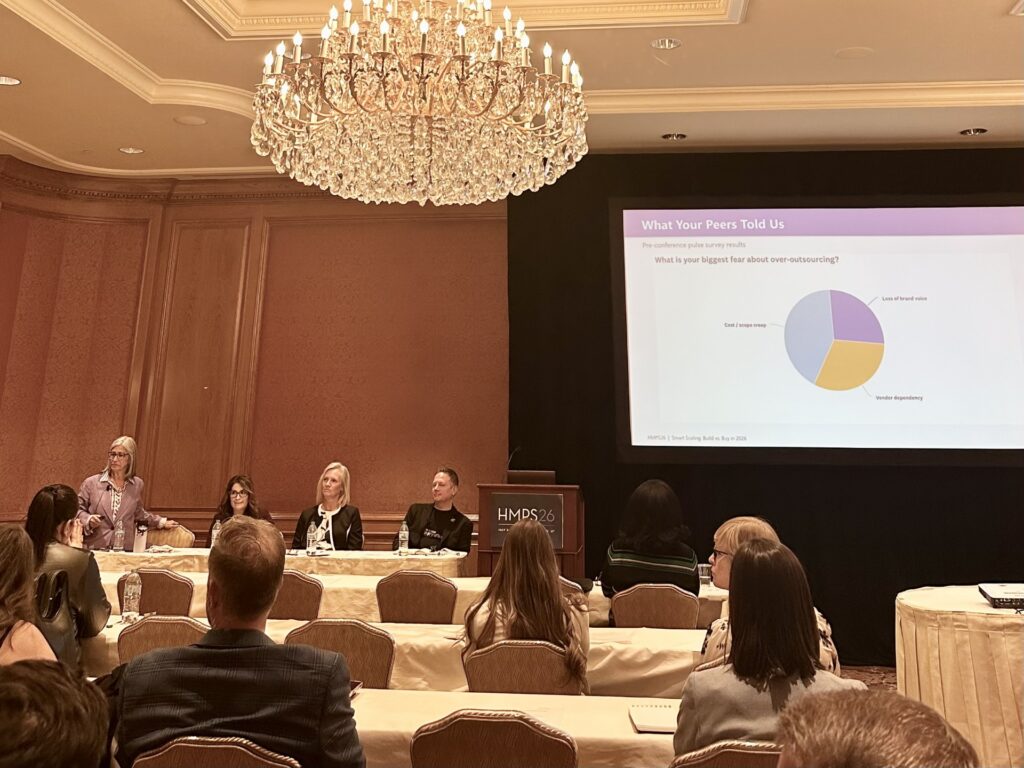
One of our favorite moments of the conference was seeing our Director of Oncology Marketing, Mindy Grantham, participate in a practical and honest panel discussion on “Build or Buy” in healthcare marketing.
The session, moderated by Laila Waggoner of Strategy for Hire, also brought together Cristal Woodley of Renown Health and Dean Browell of Feedback for a conversation about how healthcare teams should decide what to build internally, what to outsource, and how to evaluate partners more intentionally.
Healthcare marketing, communications, digital, and growth teams are facing shrinking budgets, rising expectations, and a rapidly expanding vendor landscape. The session focused on the challenge of making these decisions as teams evaluate capabilities, partners, AI, automation, and external expertise.
The most useful part of the conversation was that it moved beyond a simple “vendor vs. internal team” debate. Rather than ask whether outsourcing is good or bad, the better questions are: What capabilities are strategic enough to own, where do we need outside expertise, and how do we make those choices without adding more complexity?
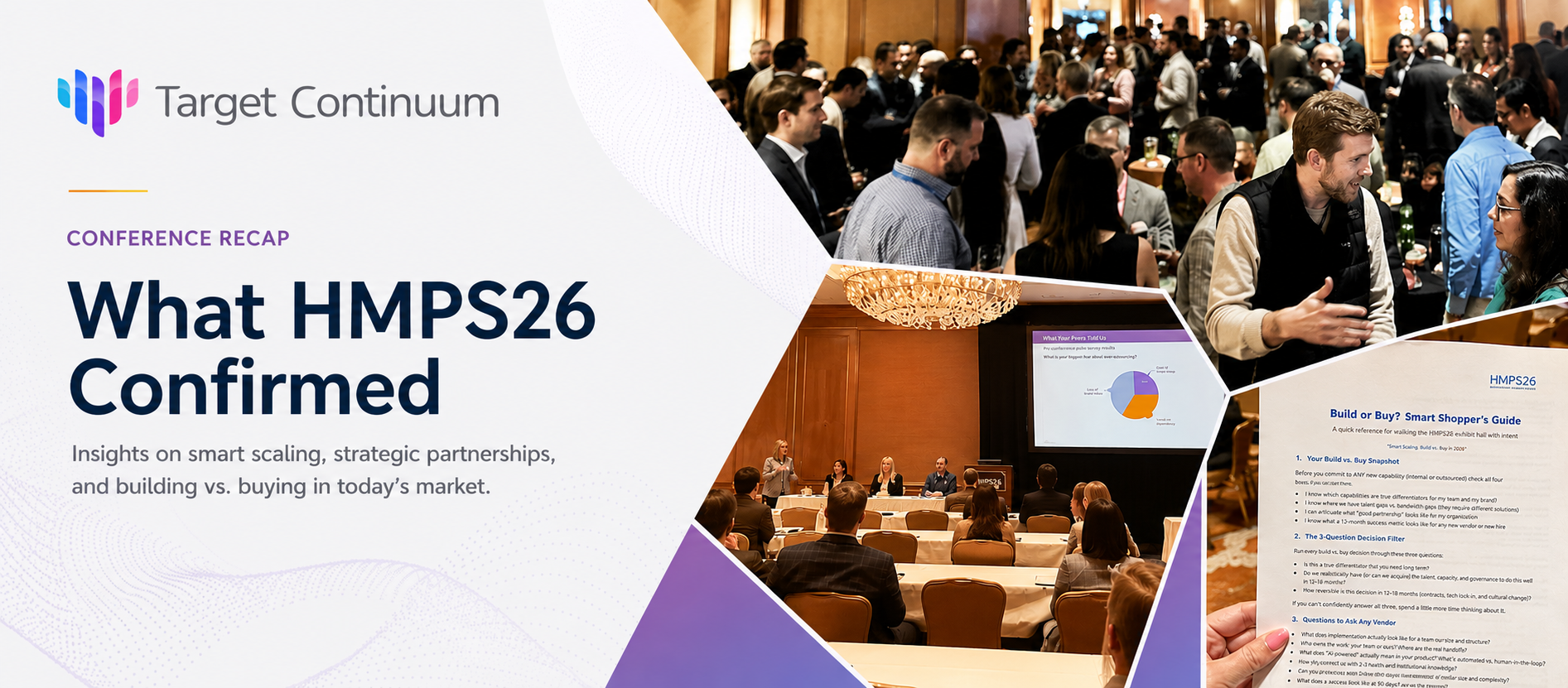
The Smart Shopper’s Guide from the session gave attendees a practical way to think about those decisions. Before committing to any new capability, whether internal or outsourced, the guide encouraged teams to clarify four things:
- Which capabilities are true differentiators
- Where they have talent gaps versus bandwidth gaps
- What “good partnership” looks like for their organization
- What a 12-month success metric should look like for any new vendor or hire
That distinction between a talent gap and a bandwidth gap matters. A bandwidth gap may mean the team needs more hands. A talent gap may mean the team needs a different kind of expertise, stronger governance, or a partner who has already solved the problem inside healthcare environments.
The session also offered a three-question decision filter that every healthcare marketing leader can use:
- Is this a true differentiator that we need long term?
- Do we realistically have, or can we acquire, the talent, capacity, and governance to do this well in the next 12 to 18 months?
- How reversible is this decision in 12 to 18 months, considering contracts, tech lock-in, and cultural change?
That last question is especially important. Too many organizations make decisions that seem efficient in the short term but become difficult to unwind later. A platform, agency, or internal structure can create momentum, but it can also create drag if it does not match the organization’s workflows, access realities, service line priorities, or growth model.
The panel also reinforced a smarter way to approach the exhibit hall. Conferences are full of strong solution providers, but the best conversations happen when teams arrive with a clear understanding of what they are shopping for. The guide encouraged attendees to ask vendors what implementation actually looks like, where the handoffs happen, what “AI-powered” really means, how brand voice and institutional knowledge are protected, and what success should look like at 90 days and 12 months.
Happy Hour, Great Partners, and Better Conversations
We also had a great time co-hosting an onsite happy hour with WG Content, Ours Privacy, Symetris, Reason One, Rater8, Core Creative, and SearchStax.
The conversations there were exactly what we value most about events like HMPS: thoughtful, candid, and grounded in the real challenges healthcare teams are trying to solve. We talked about privacy-first marketing, AI search, reputation, patient access, digital experience, and what it takes to build a smarter partner ecosystem around health system growth.
That kind of collaboration matters. No single agency, platform, or internal team can solve every piece of the patient acquisition puzzle alone. The future belongs to organizations that know what they need to own, where they need the right partners, and how to connect the work into a strategy that patients, physicians, operators, and executives can all trust.
Our Biggest Takeaway
HMPS26 confirmed something we believe deeply at Target Continuum: healthcare marketing is becoming more accountable, more integrated, and more operationally connected.
The organizations that make the most progress will be the ones that diagnose before they scale. They will understand their market reality, validate access and capacity, evaluate referral dynamics, improve marketing conversion, and build AI-ready infrastructure with trust and governance in mind.
That is the heart of our Unified Patient Acquisition Method.
And after HMPS, we are more convinced than ever that this is the conversation healthcare growth leaders need now.