Healthcare marketing is becoming increasingly measurable, but not all measurement tells the same story. Our team here at Target Continuum has learned that some of the most valuable conversations we have with clients involve helping them understand the difference between marketing attribution and patient acquisition attribution.
Both are important. Both answer different questions. And understanding when to use each one often leads to better decisions, stronger reporting, and a clearer view of what’s actually driving patient growth.
Many healthcare organizations invest significant time and resources into tracking website traffic, clicks, form submissions, and campaign engagement. These metrics provide valuable insight into how marketing is performing. However, they don’t always tell the full story of how marketing contributes to organizational growth.
We try to help our clients understand when marketing attribution is the best approach and when it’s better to evaluate patient acquisition attribution. The organizations that understand both perspectives are often able to make more informed decisions about budget allocation, service line growth strategies, and overall marketing performance.
Two Different Ways to Measure Success
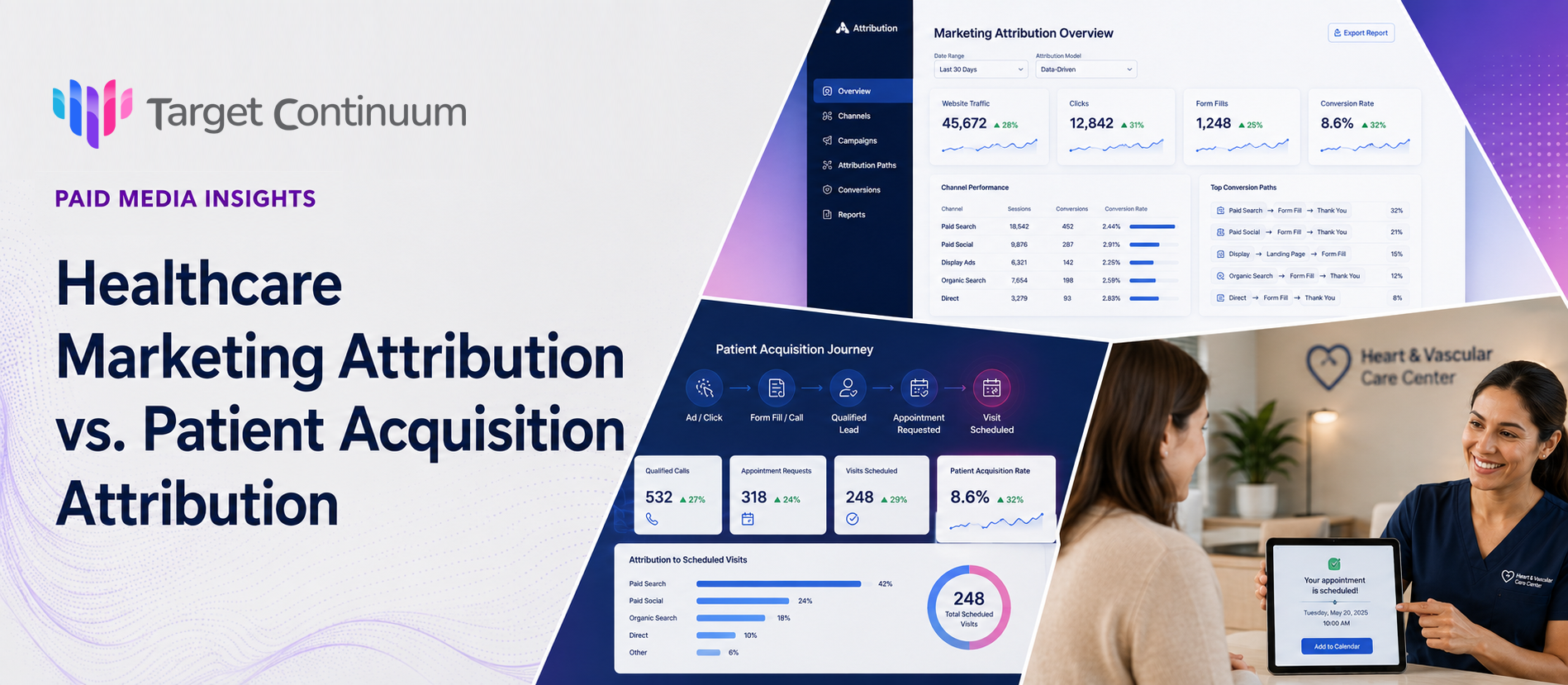
Marketing attribution focuses on the activities that occur within the marketing funnel. It helps answer questions such as:
- Which campaigns are generating traffic?
- Which channels are producing conversions?
- Which messages are resonating with prospective patients?
- How efficiently is advertising spend generating engagement?
For example, a health system may launch a paid search campaign promoting orthopedic services. Marketing attribution can show how many people clicked the ads, visited the website, submitted a form, or called a tracking number. These insights are extremely valuable because they help marketers optimize campaigns and understand channel performance.
Patient acquisition attribution looks at what happens next.
Rather than focusing solely on marketing activity, it seeks to understand how marketing contributes to actual patient growth. This includes outcomes such as qualified calls, appointment requests, scheduled appointments, new patient visits, and service line growth.
Using the same orthopedic example, patient acquisition attribution would seek to answer questions such as:
- How many appointments were scheduled?
- How many of those appointments were new patients?
- Which campaigns influenced those appointments?
- What was the cost of acquiring each patient?
The difference may seem subtle, but it can dramatically change how success is evaluated.
Why This Matters in Healthcare
Unlike many industries, healthcare decisions rarely happen in a single session.
A patient experiencing knee pain may search online, click an ad, visit a website, leave, return several days later, call a scheduling center, ask questions about insurance coverage, and schedule an appointment the following week.
A parent searching for a pediatrician may visit multiple provider websites before making a decision.
A prospective senior living resident and their family members may spend months researching options before scheduling a tour.
Traditional marketing attribution often captures only part of these journeys. Healthcare marketers need additional visibility into what happens after the click.
This is one reason why patient acquisition attribution has become increasingly important.
Real-World Examples
We’ve worked with organizations where campaign performance looked very different depending on which measurement lens was being used.
In one scenario, a campaign generated fewer form submissions than the previous reporting period. Looking only at marketing attribution, it appeared performance had declined.
However, a closer review showed that qualified phone calls had increased significantly, and appointment requests were up. The campaign was actually generating more patient opportunities than before.
In another situation, a campaign delivered a large volume of website conversions, but many of those leads were not highly qualified. Marketing attribution suggested strong performance, but patient acquisition attribution revealed that relatively few appointments were ultimately being scheduled.
Neither measurement approach was wrong. They were simply telling different parts of the story.
How AI Is Helping Close the Gap
One of the most exciting developments in healthcare marketing is the growing ability to connect marketing activity with patient outcomes.
Historically, healthcare marketers could track whether a phone call occurred, but they often had limited visibility into what happened during that conversation. Today, AI-powered call tracking platforms can provide much deeper insights.
For example, AI can analyze conversations and help determine whether a caller actually scheduled an appointment, requested additional information, or simply called the wrong department. Some solutions can even identify call sentiment and categorize outcomes automatically.
This creates a much stronger connection between campaign performance and patient acquisition. Instead of simply reporting that a campaign generated a hundred calls, healthcare marketers can begin to understand how many of those calls contributed to meaningful business outcomes.
What Healthcare Leaders Should Measure
There is no universal dashboard that works for every healthcare organization.
Marketing attribution remains essential because it helps marketers understand campaign performance and optimize investments. Patient acquisition attribution provides additional context that helps leadership understand growth outcomes.
The strongest reporting frameworks often include both.
Marketing attribution metrics may include:
- Website traffic
- Click-through rates
- Conversion volume
- Cost per click
- Campaign engagement
Patient acquisition attribution metrics may include:
- Qualified calls
- Appointment requests
- Scheduled appointments
- Cost per appointment
- Patient acquisition cost
- Service line growth
- Market share growth
Together, these metrics provide a more complete view of performance.
Bringing It All Together
Marketing attribution helps organizations understand how campaigns are performing. Patient acquisition attribution helps organizations understand how marketing contributes to growth. Healthcare marketing measurement is about understanding the role each one plays.
Our team at Target Continuum has found that healthcare organizations achieve the strongest results when they look at both perspectives together. Doing so creates a clearer understanding of what is driving patient demand, where opportunities exist for improvement, and how marketing investments are contributing to organizational goals.
Ready to Learn More?
Speak with a paid media expert on our team and learn how we can help today.