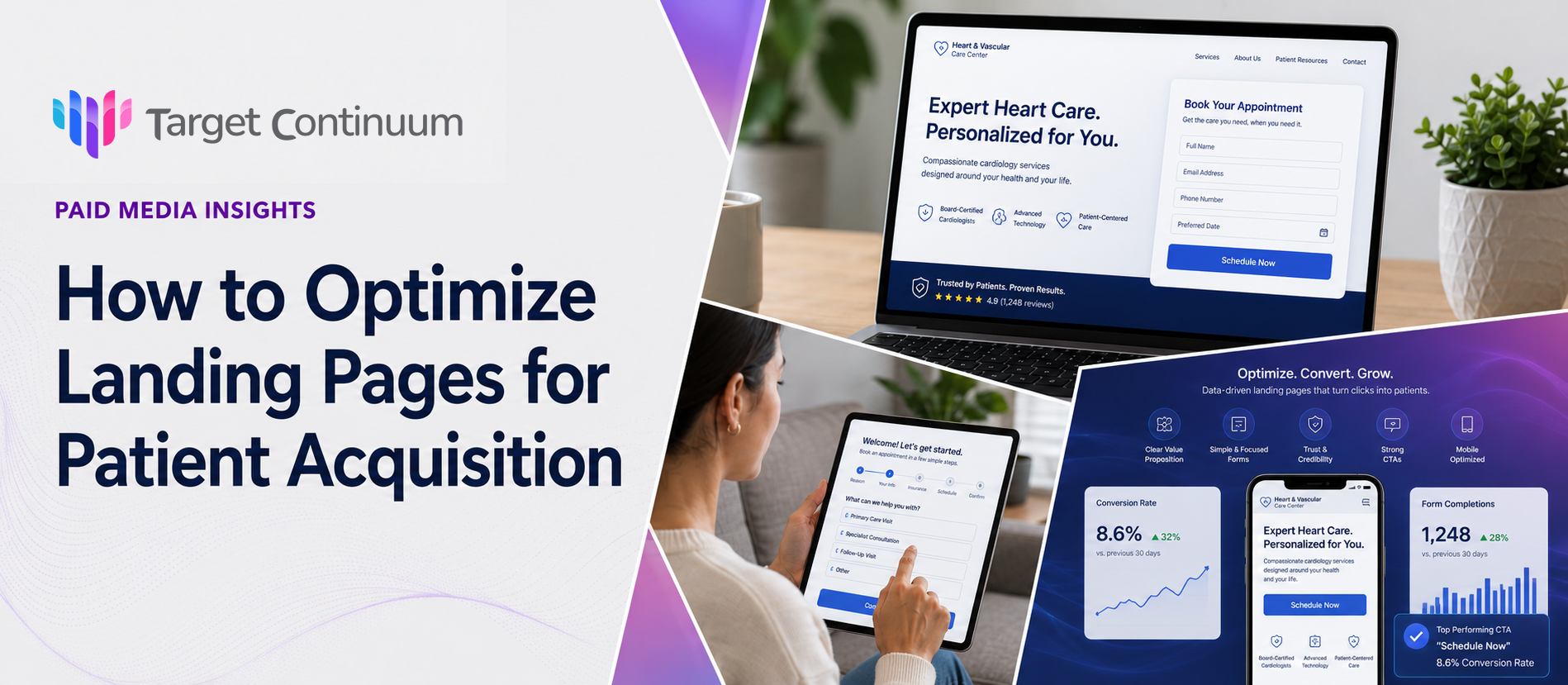
How to Optimize Landing Pages for Patient Acquisition

The landing page experience plays a critical role in determining whether a prospective patient takes the next step or leaves without converting. In fact, landing page quality directly influences ad performance, conversion rates, and acquisition costs.

At Target Continuum, we’ve seen that the highest-performing campaigns connect advertising strategy with patient-focused landing page experiences designed to guide visitors toward action.

Why Landing Pages Matter for Campaign Performance

In general, website pages offer visitors many options encouraging users to interact and engage with the site. This is important for optimizing your site and increasing your organic search results.

Landing pages, on the other hand, are focused on the call-to-action (CTA) and guide users down the path to complete the desired CTA. By eliminating most sublinks, they are much better suited for converting visitors into leads.

The quality and experience of your landing page has a direct impact on:

  • Ad Quality Score: an estimate of the quality of your ads, keywords, and landing pages
  • Ad Rank: your ad position and whether your ad shows at all in search results
  • Cost Per Acquisition (CPA): the cost of a lead for a conversion or phone call

Best Practices for Landing Pages

Here are six landing page best practices to maximize patient acquisition.

  1. Use Clean, Professional Design

Patients form impressions quickly. A landing page should immediately convey professionalism, trust, and credibility while reflecting your organization’s brand standards. Clean layouts, thoughtful spacing, intuitive design, and visual consistency help visitors focus on the information that matters most. The goal is not to impress visitors with complexity. The goal is to make it easy for them to understand what you offer and what they should do next.

  1. Keep Content Relevant and Concise

While website pages are often designed to provide comprehensive information and support SEO efforts, landing pages are designed to support a specific campaign objective.

The most effective landing pages answer a few critical questions quickly:<?p>

  • What service is being promoted?
  • Who is it for?
  • Why should the patient trust you?
  • What should they do next?

When messaging aligns closely with the keywords and ad copy that brought visitors to the page, we see that user experience and campaign performance both improve.

  1. Create Clear Calls-to-Action

Every landing page should have a primary goal. Whether the objective is scheduling an appointment, requesting a consultation, completing a health risk assessment, or calling a care team, the call-to-action should be obvious and easy to complete.

Strong CTAs remove ambiguity. Visitors should immediately understand the next step and feel confident taking it. Examples include:

  • Schedule an Appointment
  • Request a Consultation
  • Book a Tour
  • Call Now
  • Complete Your Assessment

The easier the action is to understand, the more likely patients are to convert.

  1. Make Content Easy to Scan

Healthcare decisions can feel overwhelming for patients. Landing pages should help simplify information rather than add complexity. Using bullet points, imagery, icons, short paragraphs, and clear headings allows visitors to quickly find the information they’re seeking. Scannable content is especially important for mobile users, who often make decisions while multitasking or researching care options on the go.

  1. Place Calls-to-Action Above the Fold

One of the simplest yet most impactful best practices is ensuring that your primary CTA is visible immediately when the page loads. Patients should not have to scroll to find the next step.

For many healthcare campaigns, this means placing appointment forms, scheduling buttons, click-to-call functionality, or consultation requests prominently near the top of the page. This becomes even more important when considering that most healthcare searches now occur on mobile devices.

  1. Remove Distractions

Website pages are designed to encourage exploration. Landing pages are designed to encourage action. That’s why high-performing landing pages often remove elements that can distract visitors from the primary conversion goal, including:

  • Full website navigation menus
  • Excessive links
  • Competing calls-to-action
  • Unnecessary pop-ups
  • Irrelevant content

Every element on the page should support the desired action and guide patients toward the next step in their journey.<?p>

Additional Healthcare-Specific Considerations

Healthcare organizations face unique requirements that extend beyond traditional conversion optimization.

HIPAA-Compliant Forms and Tracking

Patient privacy must be built into every landing page experience. Forms, analytics platforms, and tracking solutions need to be implemented with compliance requirements in mind.

Consent Management

Modern healthcare marketing increasingly requires robust consent management practices that accurately capture and honor user preferences.

Mobile-First Design

With the majority of healthcare searches occurring on mobile devices, every landing page should be optimized for smaller screens, touch navigation, and click-to-call functionality.

Bringing It All Together

Successful patient acquisition requires creating a seamless path from search to action. The best healthcare landing pages remove friction, reinforce trust, and make it easy for patients to take the next step. When designed strategically, they become one of the most powerful tools available for improving campaign performance and helping more patients access care.

Ready to Learn More?

Speak with a paid media expert on our team and learn how we can help today.

Related Articles