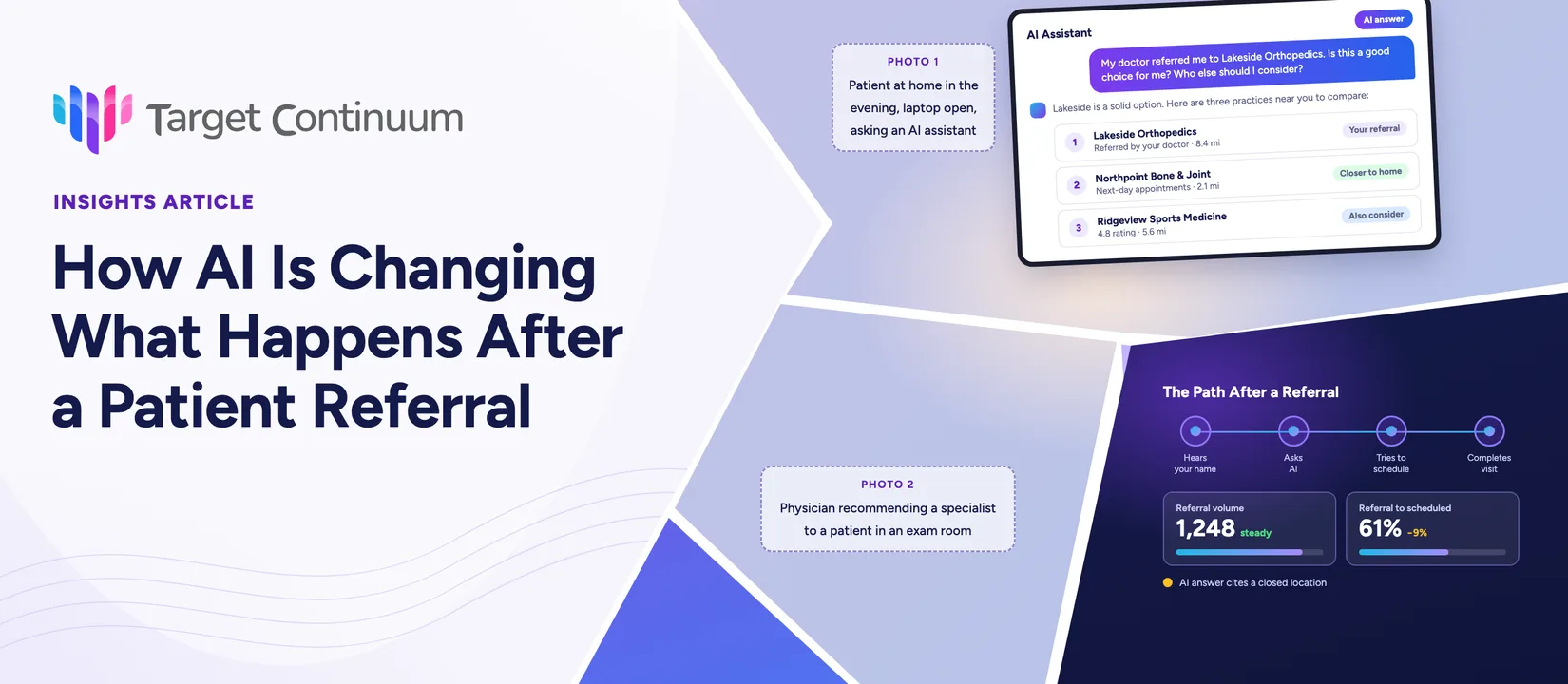
AI can disrupt a referral today, even when the referring physician and liaison have done everything right.
Take this scenario for example:
A physician liaison spends months building a relationship with a primary care practice. A doctor there recommends your orthopedics group to a patient. That evening, the patient asks an AI assistant, “Is this a good choice for me? Who else should I consider?”
The answer may reinforce the doctor’s recommendation. It may also surface two other practices, highlight a location closer to home, or give the patient outdated information about your services. By the time your scheduling team calls, the patient may already be considering a different provider.
A referral can start a search
Patients and families will always spend time researching where to go for care. AI makes it easier to turn that research into a shortlist. In one conversation, someone can ask who offers a particular service, which locations are closest, and what they should ask before booking. In a June 2026 KFF poll, 29% of U.S. adults said they use AI tools or chatbots at least monthly for health information or advice. That figure points to a habit healthcare organizations need to account for as patients decide where to seek care.
The same dynamic applies to word-of-mouth referrals in senior living. A friend recommends a community, and a family member asks an AI assistant to compare it with other options near a sibling’s home. They may ask about care levels, costs, or what happens if a parent’s needs change. If the answer describes another community in more useful detail, that community may get the first tour.
Referral volume can hide what happens next
A referral report can tell you how many patients were directed to you. It may tell you how many scheduled and how many completed a visit. It can be harder to see what happened between the recommendation and the decision. A patient who quietly chooses another provider may leave your team with little more than an unreturned call.
What can you do at that point? If referral volume holds steady while fewer patients schedule, review the usual suspects first:
- How long did it take to reach patients?
- How soon could they be seen?
- Did they run into insurance or location barriers?
Then look at what someone researching the referral would find. Your access team may never get the chance to address a concerned raised by an AI answer that points to a closed location or overlooks a service you offer. If conversions are dropping, take the opportunity to investigate.
The stakes are especially clear in senior living, where a community might average $110,000 in revenue per resident over their stay. Those figures compound quickly with multiple vacancies, making it important to address referral interruptions.
Make the referral easier to verify
So where do you start? Every organization can benefit from starting with the following steps:
- Start with one service line or community where referrals matter to growth. Ask your schedulers, liaisons, or admissions team what people want to know before they commit. Turn those questions into a short set of prompts and test them without using patient information.
- Ask about your organization by name, then try the same questions without naming it. The first shows what someone might see after a referral. The second shows whether someone exploring their options would find you in the first place.
- Look closely at what the answers get right, what they leave out, and which sources they cite. Can someone verify which location offers the service? Is there a clear next step? Do your website, provider profiles, and directories agree?
- Give patients and families a reliable place to confirm those answers, and share it with the people who refer to you. Clear, consistent public information gives AI tools better sources to draw from and gives patients a direct way to check what they read.
- Compare what you find with what your team hears. A simple question such as “What did you look up before calling us?” can surface where patients are getting information and which details are causing confusion. Track those themes alongside referral-to-scheduled and scheduled-to-completed rates, or inquiry-to-tour and tour-to-move-in rates for senior living.
Look at the whole path to care
Target Continuum’s Unified Patient Acquisition Method looks at referral confidence, access, conversion, and AI visibility together. That matters when the same symptom, such as fewer referred patients completing a visit, could reflect a scheduling delay, an inaccurate answer online, or several issues at once. The goal is to find where people are getting stuck so you can fix the part of the experience that’s costing them time or confidence.
The most useful place to start is with a referral you already receive. Follow it from the patient’s side, from hearing your name to looking you up to trying to schedule. You’ll see where the recommendation is reinforced, where it gets harder to act on, and what someone who has never heard of you might find along the way.